Bad Air Days and Your Liver: How AQI and Air Pollution Affect Liver Health
When the city wakes up to smog, we think of our lungs and heart. But the tiny particles in polluted air also travel through the blood – and the liver, which filters that blood, may feel the effects too. Here's what research tells us about air quality and liver health, and the simple steps that help on bad air days.
This article is for general education. The link between air pollution and liver disease comes mainly from population studies – diet, weight, alcohol and hepatitis remain far bigger causes of liver disease.
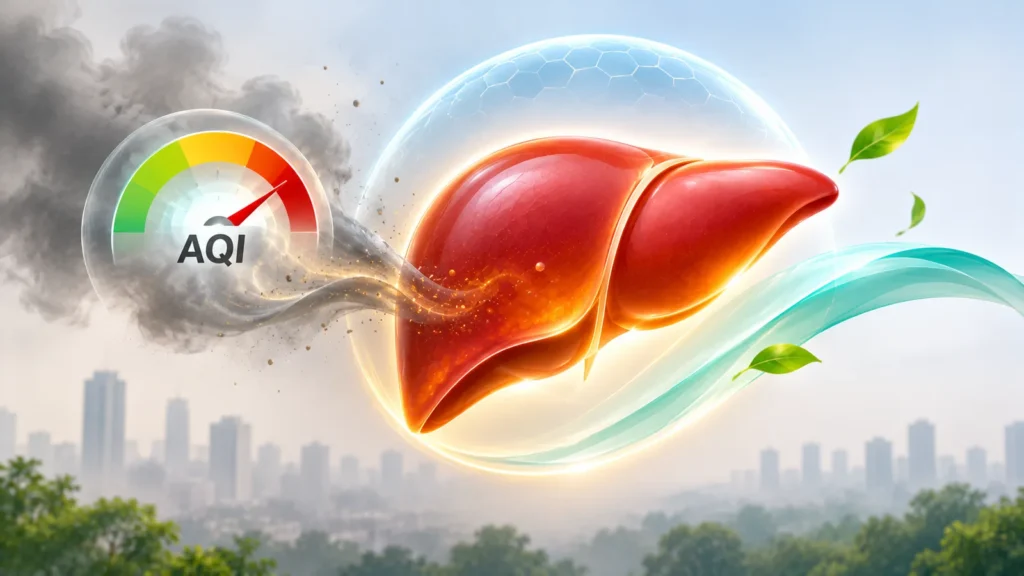
Long-term exposure to air pollution, especially fine particles called PM2.5, is linked with a higher risk of fatty liver and, in large studies, a modestly higher risk of severe liver disease. A review of 12 studies found that every 10 µg/m³ rise in long-term PM2.5 was linked with about 22% higher odds of fatty liver. On days when the AQI is Poor (201–300) or worse, people with liver disease should move exercise indoors, wear an N95 or N99 mask outside, and keep indoor air clean.
How polluted air can reach your liver
The air quality index (AQI) is driven largely by fine particles called PM2.5 – each about 30 times thinner than a human hair. They are small enough to pass deep into the lungs, and the smallest can enter the bloodstream.
The liver filters all the blood coming from the gut and receives blood from the rest of the body. Laboratory studies suggest that pollutants can trigger three processes in the liver:
Pollutants create harmful molecules that damage liver cells.
The body's inflammatory response to pollution reaches the liver as well as the lungs.
Pollution can make insulin work less well – the same process that drives fatty liver and type 2 diabetes.
What the studies say about air pollution and the liver
Each 10 µg/m³ rise in long-term PM2.5 exposure was linked with about 22% higher odds of fatty liver; nitrogen dioxide (NO2, mainly from traffic) with about 10% higher odds.
People exposed to more air pollution had a modestly higher risk of severe liver disease – cirrhosis, liver failure or liver cancer. More green space near home was linked with a lower risk.
The link was stronger in smokers, people with high blood pressure, and people whose liver tests already suggested scarring.
What this means: these studies show a link, not proof that pollution directly causes liver disease. The effect is smaller than that of diet, weight, alcohol or hepatitis – but because everyone in a city breathes the same air, it matters for public health, and it adds to the strain on an already unhealthy liver.
What the AQI numbers mean for you
India's AQI runs from 0 to 500. In Mumbai, air quality usually worsens after the monsoon and through winter: in winter 2025–26, about 45% of days exceeded India's 24-hour PM2.5 standard.
Slide to see what the AQI means
- Good · 0–50
Enjoy outdoor activity.
- Satisfactory · 51–100
Normal activity; sensitive people watch for symptoms.
- Moderate · 101–200
People with cirrhosis, a liver transplant, lung or heart disease: reduce long or strenuous outdoor exercise.
- Poor · 201–300
Move exercise indoors. Wear an N95 or N99 mask outside.
- Very poor · 301–400
Stay indoors as much as possible and keep activity light. Keep windows closed during peak hours.
- Severe · 401–500
Avoid going out unless necessary. Use an air purifier indoors if you can.
Who needs to take more care on bad air days
A scarred liver has less reserve, and infections hit harder. Limit outdoor exposure on Poor-or-worse days and keep your vaccinations up to date.
Anti-rejection medicines lower immunity. Wear an N95 mask in polluted or crowded places, and call your transplant team early if you develop a cough or fever.
Pollution may add to insulin resistance. Keep exercising – but indoors on bad air days.
More sensitive to polluted air.
Advised to limit exposure on Poor-or-worse days.
Smoking adds to the effect of pollution on the liver – another strong reason to stop.
Eight ways to protect your liver on high-AQI days
All done – well looked after.
Four myths about pollution and the liver
Key takeaways
- Fine particles (PM2.5) can reach the blood, and long-term exposure is linked with fatty liver and severe liver disease.
- The evidence shows a link, not proof of cause – diet, weight, alcohol and hepatitis matter more.
- On Poor-or-worse AQI days, move exercise indoors and wear an N95 or N99 mask outside.
- People with cirrhosis, a liver transplant or fatty liver with diabetes should take extra care.
- Detox drinks don't remove pollution; clean indoor air, no smoking and no alcohol do help.
Quick answers
Does air pollution affect the liver?
Studies link long-term exposure to air pollution, especially PM2.5, with a higher risk of fatty liver and, in large studies, a modestly higher risk of severe liver disease. Laboratory research suggests pollutants cause oxidative stress, inflammation and insulin resistance in the liver.
Can air pollution cause fatty liver?
It is linked with a higher chance of fatty liver, but it is not proven to be a direct cause. Diet, weight, diabetes and alcohol remain the main causes.
Should people with liver disease wear a mask when the AQI is high?
Yes. On Poor-or-worse AQI days, a well-fitted N95 or N99 mask helps when going outside. This is especially important for people with cirrhosis or a liver transplant.
Is it safe to walk outside with fatty liver when the AQI is high?
On days when the AQI is above 200, it's better to exercise indoors – at home, in a gym or in a mall. Keep exercising, because it remains one of the best treatments for fatty liver.
Do air purifiers help?
A purifier with a HEPA filter can reduce fine particles indoors, especially in a closed bedroom. Keep windows closed while it runs.
Can a liver detox remove pollution from my body?
No. There is no evidence that detox drinks or powders remove pollutants, and some herbal products can harm the liver.
References
- Association between air pollution and risk of non-alcoholic fatty liver disease: an updated meta-analysis. Frontiers in Public Health, 2025.
- Ye et al. Ambient air pollutants, residential green spaces, FIB-4 scores, genetic susceptibility and risk of severe liver disease (UK Biobank). Ecotoxicology and Environmental Safety, 2023.
- National Centre for Disease Control, Ministry of Health & Family Welfare. Advisory on air pollution and health, 2024.
- Newslaundry analysis of CPCB data: Mumbai winter air quality, 2021–2026 (March 2026).